What Barangay names reveal about the Filipino soul
From saints to plants, from heroes to ancient words — barangay names offer a glimpse into the Philippines’ diverse history and culture
From saints to plants, from heroes to ancient words — barangay names offer a glimpse into the Philippines’ diverse history and culture
In the Philippines, place names are not just geographic markers. They are cultural artifacts – fragments of memory that map out history, belief, and the shape of everyday life.
The barangay, the Philippines' smallest unit of government, often carries more than a bureaucratic label. Its name can hint at what the land once looked like, who once lived there, or what people hoped for.
This story examines nearly 4,000 barangays across Mega Manila – a vast, urbanized region where one in four Filipinos now lives – to explore how these names reflect how Filipinos shape identity, meaning, and geography.
The word "barangay" traces its roots to balangay – the ancient wooden boats that once carried Malay settlers from Borneo and beyond across the seas to the Philippine archipelago.
Each balangay carried extended families, their leaders (datus), and sometimes slaves. Over time, the term shifted from describing the vessel to the community that disembarked from it.
In precolonial times, barangays were small, autonomous settlements along rivers or coasts, often consisting of 30 to 100 families. These were not part of a nation but scattered, independent villages tied together by water and kinship.
When the Spaniards came, the colonizers preserved the barangay structure for administrative ease. Americans later renamed them barrios, until dictator Ferdinand Marcos revived the term in the 1970s to strengthen centralized control.
Today, there are more than 42,000 barangays across the Philippines. One in ten is in Mega Manila, the metropolitan sprawl that includes the capital region and the nearby provinces of Bulacan, Cavite, Laguna, and Rizal.
The capital itself, Manila, holds the distinction of having nearly 900 barangays – the highest in the country. Uniquely, every barangay in Manila is named with a number: Barangay 1, Barangay 2, and so on – a legacy of urban planning, not storytelling.
Cavite, just south of Manila, follows with 829 barangays, a province closely associated with Filipino revolutionary history.
Colonial rule shaped not only governance but also naming. Like many former Spanish colonies, the old pueblo (town center) was organized around four points: a church, a municipal hall, a market, and a central plaza. Many barangays grew around these.
The second most common name after “Barangay” is Poblacion – from the Spanish for “population,” now understood to mean the town proper in the Philippines. At least 67 barangays in Mega Manila carry this name or a numbered variation.
Then come the saints:
Given the Philippines' status as the world's third-largest Catholic nation, this saturation is no surprise. Yet the density of saintly names reveals how deeply religion has shaped public life — not just as faith, but as geography.
These names reflect the influence of the clergy during the Spanish colonial era and the long-standing practice of invoking saints as protectors of the community.
Though these names are remnants of colonial rule, they show how faith continues to shape public identity — even long after the priests lost political power.
Despite a sea of utilitarian names, a closer look reveals a textured landscape.
Another major source of naming draws from the land itself.
Many barangays are named after physical landmarks: Wawa (river mouth), Longos (land jutting into water), Burol (hill), Pulo (island).
Ten barangays are named Bukal or Bucal, both meaning “spring.” Four are called Pansol, which also means spring. In Laguna, Bucal and Pansol are popular tourist destinations known for their natural hot springs.
Names like Tabing Ilog (riverside) and Tabing Dagat (seaside) are straightforward. Tabing Ilog in Tanay, Rizal, is bisected by the Tanay River. Tabing Dagat in Bacoor, Cavite, sits along Bacoor Bay. These names often acted like oral signage – directing people to water, to safety, to sustenance.
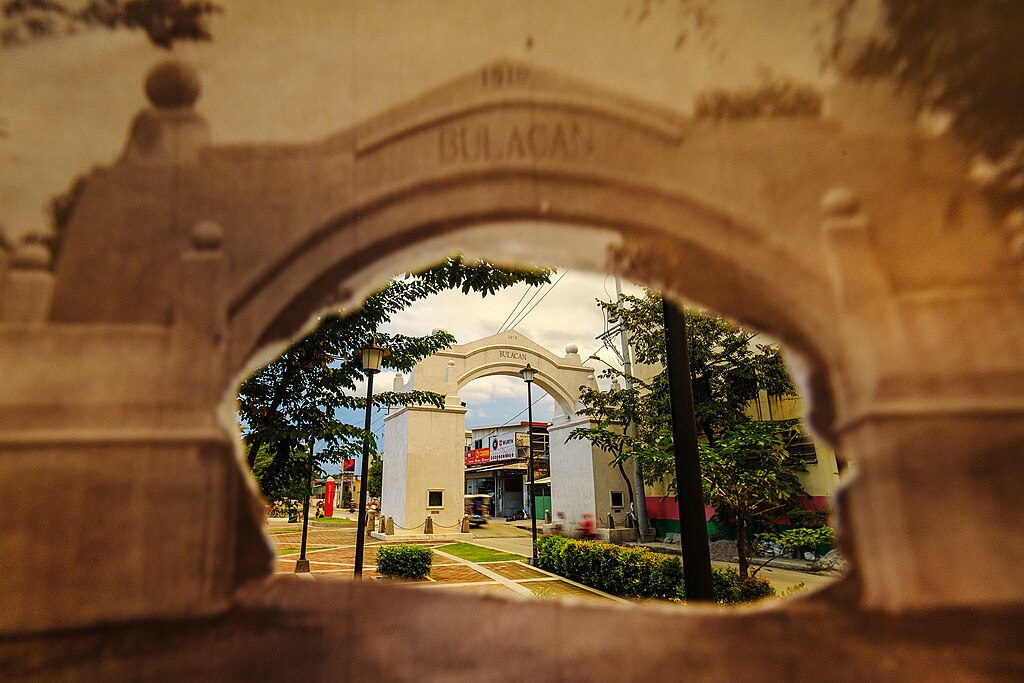
In Valenzuela City, Arkong Bato (Stone Arch) is named after a 1910 stone archway built during American rule. Once marking the boundary between Rizal and Bulacan provinces, it still stands – now separating Valenzuela and Malabon, two cities in the capital region.
Other names speak to livelihood. In Bacoor, Cavite, villages like Zapote (sapodilla), Sineguelasan (Spanish plum), Talaba (oyster), Niog (coconut), Mabolo (velvet apple), and Atisan (sugar apple orchard) reflect this.
Elsewhere, barangays carry names of trees: Bangkal (Leichhardt tree), Calumpang (wild almond), Camachile (Manila tamarind), Catmon, Acacia, and Yakal – hinting at local ecosystems or agricultural roots.
And of course, while it is not as common as saints, more than a hundred villages are named after people – local heroes and politicians included.
Eight villages carry the name of the national hero Jose Rizal – as Rizal, J. Rizal, or Jose Rizal. His brother Paciano, himself a local hero from Laguna, has two barangays named after him.
Former presidents – [Ramon] Magsaysay, [Elipidio] Quirino, Jose Laurel, [Manuel] Roxas – also appear in barangay names, even though none of them came from those areas.
Some names sit outside the expected categories – neither religious nor geographic, not historical or ecological. They reflect something more abstract.
A barangay like Pag-asa (Hope) doesn't describe a terrain – it describes a feeling. Kalayaan (Freedom) evokes a principle, not a place.
Then there are barangays Bagumbayan or Bagong Bayan (New Town), Buenavista (beautiful view), Maharlika (royalty).
Others seem almost cryptic. Julugan, in Tanza, might derive from a word meaning “to dangle,” but its etymology remains debated. In Malabon City, Tonsuya is said to come from the phrase “Tonsuy, Ah!” which is a local legend involving a Chinese merchant.
Tunasan, in Muntinlupa, has multiple origin myths. One claims it was named after a local datu, Tuna Asomal. Another links it to tulisanes – highway bandits – suggesting a past either feared or romanticized.
These outliers remind us that barangay names don't always follow rules. Some are poetic, others blunt. Some honor ancestors, others commemorate moments. Many remain mysteries. But all of them do what names do best: they locate us – in memory, in place, in story.
In Mega Manila, barangay names reflect the layered identity of the Philippines: shaped by colonization and geography, steeped in faith, stitched with aspiration and rebellion.
Some names are repeated across cities. Others are singular, tethered to forgotten legends or living memories.
But all are part of how the country remembers – not through monuments, but through language embedded in the everyday.
And if you look closely, your barangay might just tell a story too.